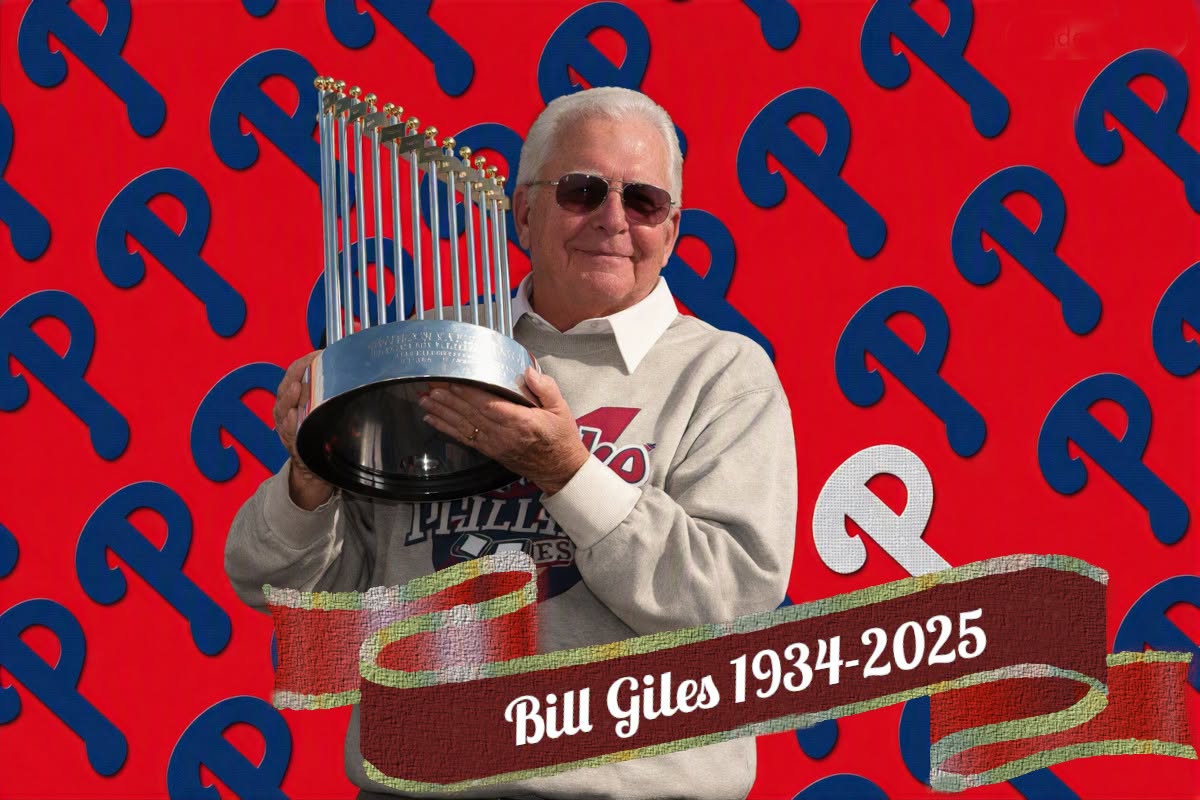
William Yale “Bill” Giles, a longtime Philadelphia Phillies executive and influential figure in Major League Baseball, has died at the age of 92.
Giles died on September 25, 2026, in Gladwyne, Pennsylvania, after a career with the Phillies that stretched across more than five decades. His death marks the loss of a prominent baseball executive whose work was closely tied to the organization and the National League.
Early Life and Baseball Beginnings
Giles was born on September 7, 1934, in Rochester, New York. Baseball was part of his family from an early age. His father, Warren C. Giles, was a Hall of Fame baseball executive who served as general manager and president of the Cincinnati Reds before becoming president of the National League.
Bill Giles began his own career in professional baseball with the Cincinnati Reds organization during the 1950s.
He later became involved with the Houston franchise that began play as the Colt .45s in 1962. His responsibilities included serving as traveling secretary, publicity director, and promotions director as the organization developed and eventually became the Houston Astros.
More Than Five Decades With the Phillies
Giles joined the Philadelphia Phillies in 1969 as vice president of business operations. He continued to rise through the organization, eventually serving as executive vice president and president.
In 1997, he became chairman of the Phillies, a position he held until 2015. He subsequently served as chairman emeritus and remained connected to the club through 2026.
One of the major milestones in his Phillies career came in 1981, when Giles became part of the ownership group that purchased the team from the Carpenter family for $30 million.
He eventually owned about 20 percent of the franchise before selling his remaining interest around 2012 or 2013.
His Lasting Place in Baseball
Giles’ connection to baseball extended beyond Philadelphia. He served as honorary president of the National League and was associated with the presentation of the Warren C. Giles Trophy, named after his father, to the National League Championship Series winner.
He also represented the league at major baseball events, including All-Star Games and postseason activities.
In 2001, the Bill Giles Invitational, a tournament featuring Div
Leave a Reply